

Every System Makes Mistakes
Why Error Is the Real Problem

Before we start, I’ve recently launched a crowdfunding campaign to fund our much needed workstation project. Just to recap, the kit we desperately need is a fast, well built PC with dual monitors, one for the experiments and the other for the results, and writing and documentation. We also need an uninterruptible power supply (UPS) and two large, fast data disks for professional level data analysis and daily, weekly and monthly backups. If you’d like to pitch in and help, you’ll find the link here.
And now, today’s post!
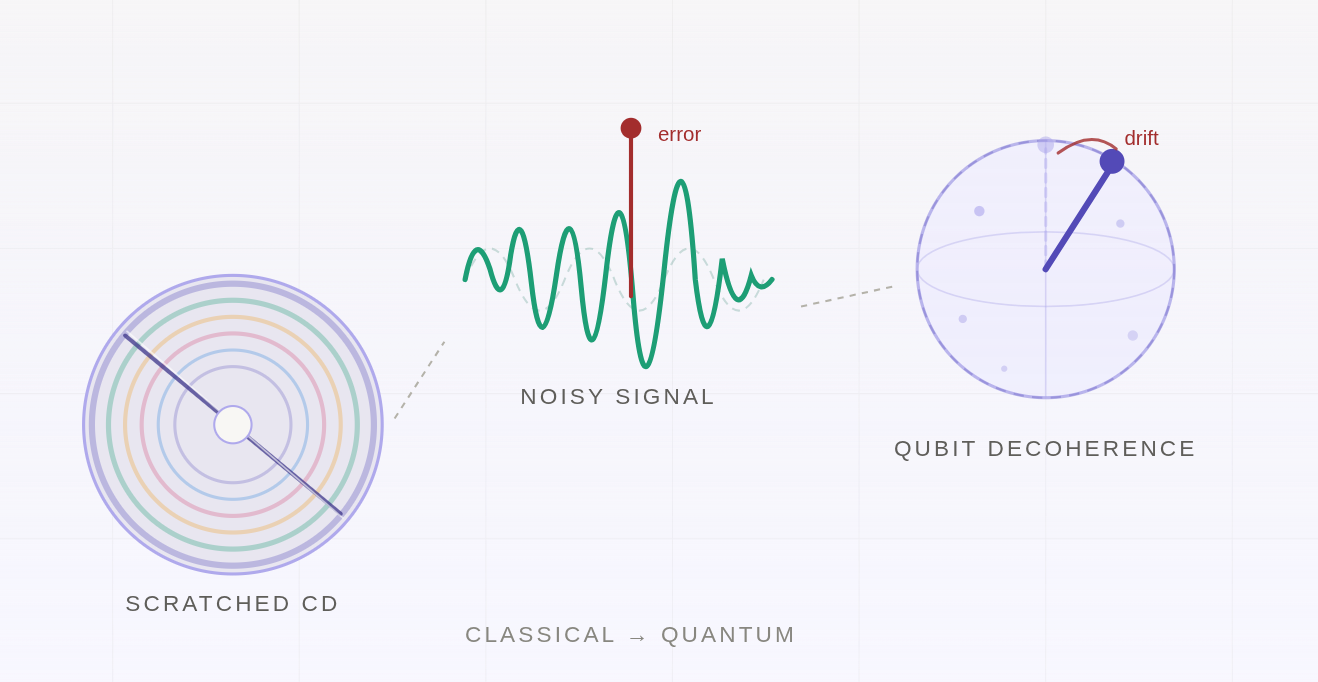
There’s a CD on a shelf somewhere in the house or there was once and at some point it started skipping. Not because the music changed. Not because the laser failed. Because a scratch, a fingerprint, a speck of dust introduced something the system wasn’t designed to tolerate i.e. an error.
We’ve been fighting errors for as long as we’ve been storing and sending information. Every communication channel, every storage medium, every computation has to contend with the gap between the message we intend and the message that actually arrives. This isn’t an engineering inconvenience. It’s a fundamental feature of physical reality. The universe does not preserve information for free.
Classical systems handle this well enough. Our phones correct transmission errors without us noticing. Hard drives use redundancy to recover from bad sectors. A text message that passes through five different networks arrives intact because error correction is woven invisibly into the infrastructure. We’ve become so good at this that most people don’t know it’s happening.
But then quantum systems enter the picture, and everything gets harder.
A classical bit is robust in a way that feels almost obvious in retrospect. It’s a 0 or a 1. It has two states, and they’re physically distinct. If something nudges a 0 toward a 1, we can usually detect it because the value is still obviously wrong. We can check it. Compare it against copies. Vote across redundant versions.
A qubit does none of these things gracefully.
A qubit exists in superposition, not just 0 or 1, but a weighted combination of both, described by a complex quantum state that carries phase information. This is the source of quantum computing’s power. It is also the source of its vulnerability.
When noise touches a qubit, it doesn’t have to flip it outright. Instead, it can rotate it slightly and thereby corrupt the phase. This would leave the qubit looking superficially correct while destroying the information it was carrying. Classical error correction looks for dramatic failures. Quantum errors can be invisible at first glance.
To talk about quantum error correction at all, we need to know about two distinct types of error.
The first is the bit flip. The quantum equivalent of the classical error we already know where a 0 becomes a 1, or vice versa. Disruptive, but at least conceptually familiar.
The second is the phase flip. This one has no real classical analogue. The qubits’ superposition doesn’t collapse, it inverts. The relative phase between its quantum states flips sign. From the outside, nothing looks obviously wrong. But the information has changed in a way that will corrupt any computation that follows.
Real quantum noise does both. It rotates states in ways that combine bit flips and phase flips simultaneously. And it does so continuously, not discretely. Therefore, quantum systems don’t fail at defined moments, they drift. They decohere. They leak their quantum character into the surrounding environment in a steady, irreversible process that can’t be stopped, only managed.
This is the central challenge. A classical computer sitting idle preserves its memory. A quantum computer sitting idle is already losing information to the environment, through tiny interactions with stray photons, vibrations, electromagnetic fields, and the imprecision of its own control systems.
Real-world quantum systems; including the kinds of quantum many-body devices being developed for sensing and simulation, operate in exactly this hostile landscape. Noise is not an edge case. It’s the default condition. Any serious quantum computation, any meaningful quantum measurement, has to be designed with the assumption that errors will occur, and that the system must be able to cope with them without shutting down.
Which brings us to the question that will run through everything that follows.
If errors are inevitable; if quantum information degrades just by existing. How do we protect quantum information at all?
The answer is quantum error correction (QEC). And the answer is stranger, more ingenious, and more demanding than anything we’d find in classical computing.
This is a whole area of study in its own right so as the weekend is already tapping on our collective shoulder we’ll start unraveling it next time. In the UK its a also a public holiday on Monday so kick back and relax, we’ll pick it up next week! Have a great weekend.
That’s all for now! If you like my efforts to make quantum science, computing and physical chemistry, more accessible to everyone; please consider recommending this newsletter on your own substack or website. Or share ExoArtDataPulse with a friend or colleague. Every recommend makes the project grow. Thanks for Reading!
Make my day! Support our workstation fundraiser here :-)