

Grids That Protect Information
Inside Surface Codes

Before we start, I’ve recently launched a crowdfunding campaign to fund our much needed workstation project. Just to recap, the kit we desperately need is a fast, well built PC with dual monitors, one for the experiments and the other for the results, and writing and documentation. We also need an uninterruptible power supply (UPS) and two large, fast data disks for professional level data analysis and daily, weekly and monthly backups. If you’d like to pitch in and help, you’ll find the link here.
Every contribution, however modest, makes a real difference. And if you’re not in a position to contribute, sharing the campaign on social media is a powerful way to help spread the word! Thank you for your support.
And now, today’s post!
So far we’ve built up the logic of quantum error correction piece by piece. Errors are inevitable. Copying is forbidden. Direct measurement destroys the state. The solution is to encode logical information non-locally across many physical qubits, and to detect faults through syndrome measurements that read correlations without touching the encoded state itself.
All of that is conceptually sound. But there’s a question it leaves hanging in the air is, how do we actually arrange the qubits? How do we choose which ones to entangle, which correlations to monitor, and how to lay the whole thing out on hardware that exists in physical space with physical constraints?
The answer that has emerged as the leading practical candidate is called the surface code. And its most striking feature, when we first encounter it, is how geometric it is. Protection doesn’t come from abstract algebra alone, it emerges from the shape of the arrangement itself.
Picture a two-dimensional lattice, chessboard-like grid. On this grid live two types of qubits, interleaved across the pattern.
The first type are data qubits. These are the physical qubits that actually carry the encoded logical information. They sit at the vertices of the lattice, or along its edges, depending on how we draw the picture. They are the things being protected.
The second type are syndrome qubits, sometimes called ancilla or measurement qubits. These sit between the data qubits, at the faces and vertices of the plaquettes that tile the grid. They don’t carry logical information themselves. Their job is to watch the data qubits, to participate in the syndrome measurements that detect whether something has gone wrong nearby.
The two types alternate across the surface in a regular, repeating pattern. Every syndrome qubit interacts with its immediate neighbors only. No qubit needs to reach across the lattice to communicate with a distant one. All the interactions are local, between nearest neighbors on the grid.
This locality is not just aesthetically pleasing. It is practically essential. Real quantum hardware has physical qubits arranged in space, with coupling limited to nearby components. A code that required long-range interactions between distant qubits would be extraordinarily difficult to build. The surface code’s nearest-neighbor structure maps naturally onto what fabrication can actually deliver.
The syndrome measurements in a surface code come in two flavors, corresponding to the two types of error a qubit can suffer.
The first type of check, sometimes called a plaquette operator or Z-type stabilizer, detects bit flip errors. It measures a correlation across a small square of four neighbouring data qubits. If all four are consistent. No bit flip has occurred among them. The measurement returns a trivial result. If one has flipped, the measurement flags it.
The second type, the vertex operator or X-type stabilizer, does the same job for phase flip errors. It interrogates a different set of four neighboring qubits, looking for phase inconsistencies rather than value inconsistencies.
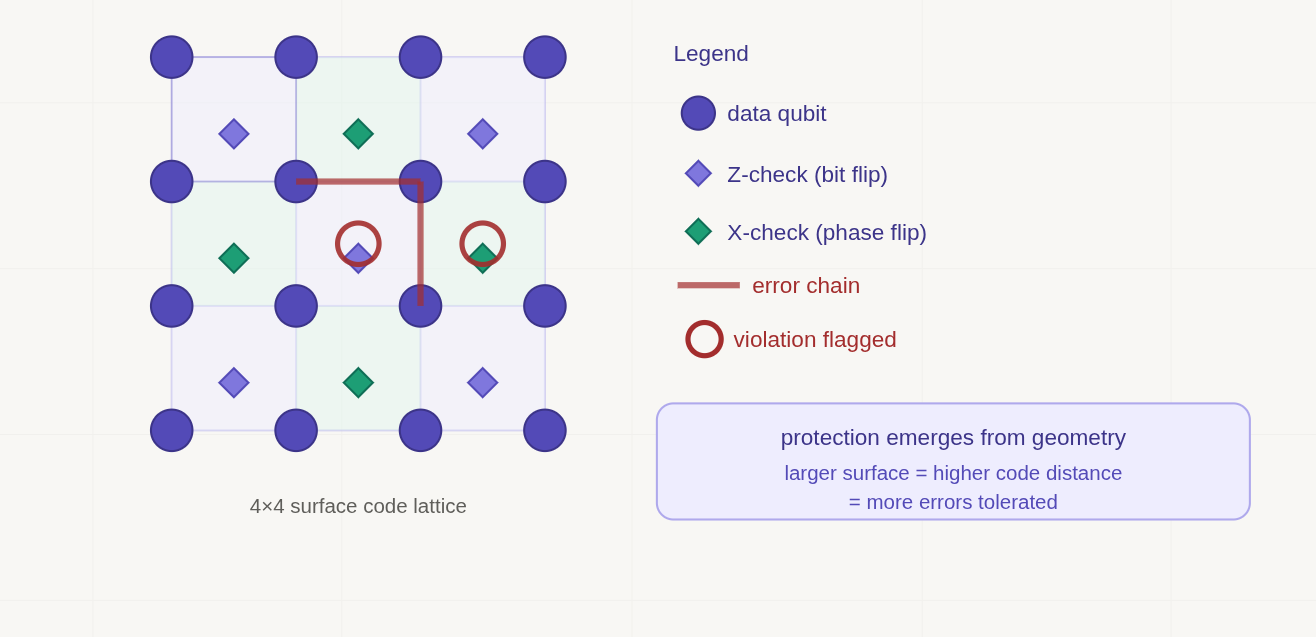
These two families of checks tile the entire surface in a repeating pattern with plaquettes and vertices alternating like the squares of a chessboard. At every cycle of operation, every syndrome qubit participates in one of these checks and reports its result. The full set of results, the syndrome, tells us where on the lattice errors have occurred, without ever revealing the logical state encoded in the data qubits. The whole surface is, in effect, continuously listening for faults.
When an error occurs on a data qubit, it doesn’t just flip a measurement somewhere. It creates a pair of syndrome violations. That is, two nearby checks that return unexpected results, flagging that something is wrong in their neighborhood.
As the error spreads, or as additional errors occur nearby, these violations move. They trace paths across the surface. A chain of bit flip errors, for instance, leaves a trail of violated Z-checks connecting its two endpoints. The endpoints show up in the syndrome data. The interior of the chain, the errors themselves is invisible. Only the tips are flagged.
This might sound like it makes diagnosis harder. In fact, it makes it tractable. A classical decoding algorithm running on ordinary hardware alongside the quantum processor reads the syndrome data and infers the most likely error chain connecting each pair of violations. It then applies corrections to cancel those errors before they accumulate into something the code can’t handle.
The code’s ability to tolerate errors is captured in a single number called the code distance. Roughly speaking, the distance tells us how many independent errors need to occur before the code fails. On a surface of distance d, any combination of fewer than d/2 errors can be detected and corrected. A larger surface means a higher distance, which means more protection. We scale up the grid, and robustness scales with it.
Protection emerges from geometry. The shape of the arrangement is the source of the protection. Larger grids protect better. The mathematics of error correction and the physics of spatial layout are, in the surface code, the same thing.
There are many quantum error correcting codes in the theoretical literature. The surface code is not the most efficient in terms of qubit overhead. We’ll meet a competing approach in a later post that uses qubits more sparingly. But it has properties that make it the current front-runner for near-term hardware.
Its syndrome measurements are local. Its error threshold, the maximum error rate per physical qubit below which the code can still function is among the highest of any known code, somewhere around one percent per operation. Its decoding can be handled by fast classical algorithms. And its two-dimensional structure maps naturally onto the planar chips that current fabrication techniques produce.
None of this makes it easy. The overhead is still substantial and we’ll look hard at that cost in a later post. Building a surface code large enough to be genuinely useful requires physical qubit counts that remain at the frontier of what current hardware can achieve.
The surface isn’t just a container for qubits. It’s an error-detecting organism, continuously checking itself, flagging disturbances, and handing the diagnosis to a classical machine that decides what to fix.
What that detection process actually looks like in operation and how we gather information about errors without ever seeing the errors directly is where we go next.
That’s all for now! If you like my efforts to make quantum science, computing and physical chemistry, more accessible to everyone; please consider recommending this newsletter on your own substack or website. Or share ExoArtDataPulse with a friend or colleague. Every recommend makes the project grow. Thanks for Reading!