

Introducing Qudits!
Before you bet the farm on qubits ...

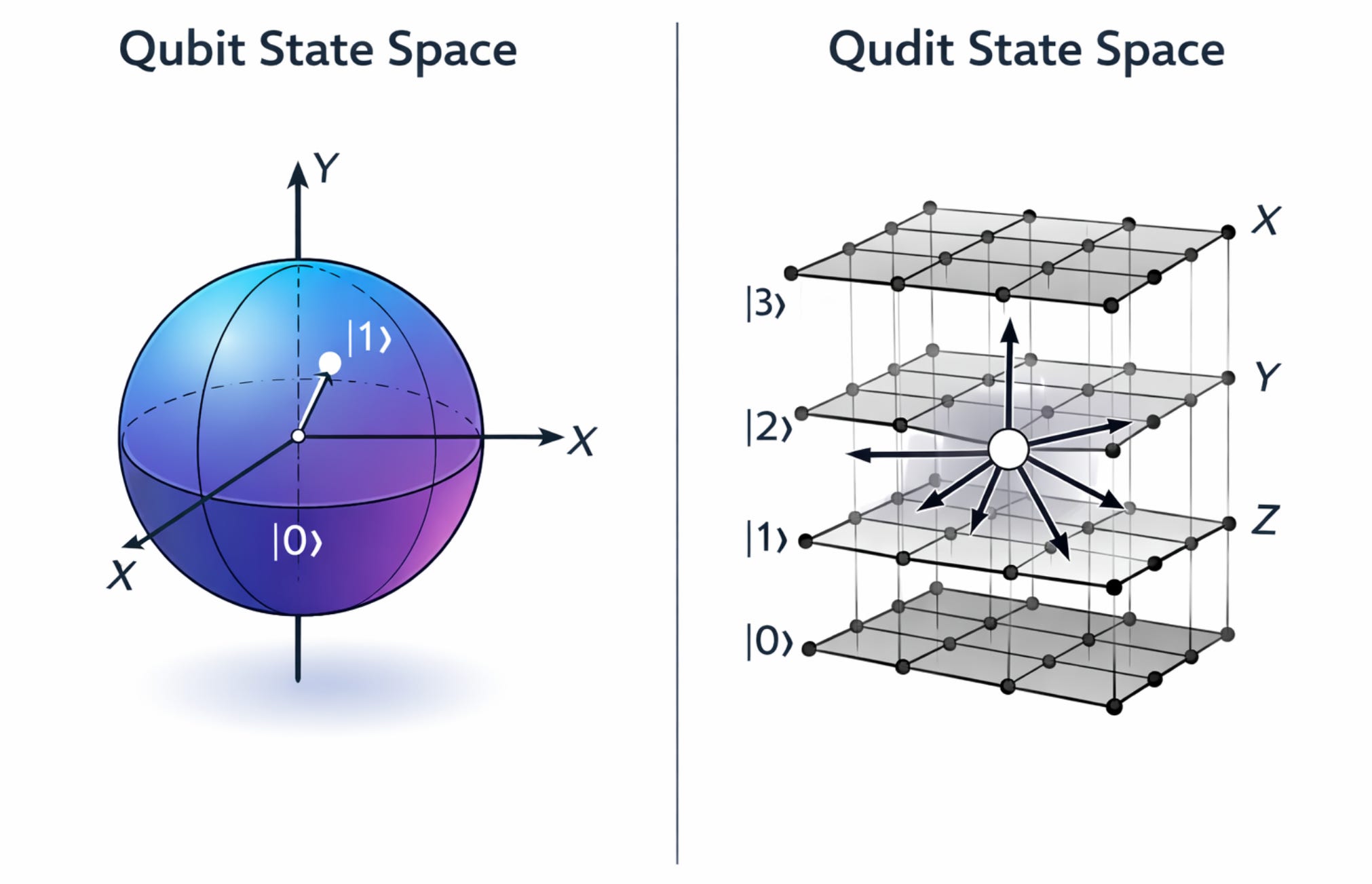
Here’s the thing. Ask anyone who has spent even a few hours reading about quantum computing, and they’re sure to be soon talking about qubits. Two level quantum systems. States written as |0⟩ and |1⟩. The quantum analogue of the classical bit.
It’s not hard to understand why. Just try explaining quantum science to a friend or neighbor and qubits just jump right in there. That’s because qubits are intuitive. They slot neatly into the mental model most people already carry from decades of exposure to classical computing and you can illustrate them very effectively using the Bloch Sphere.
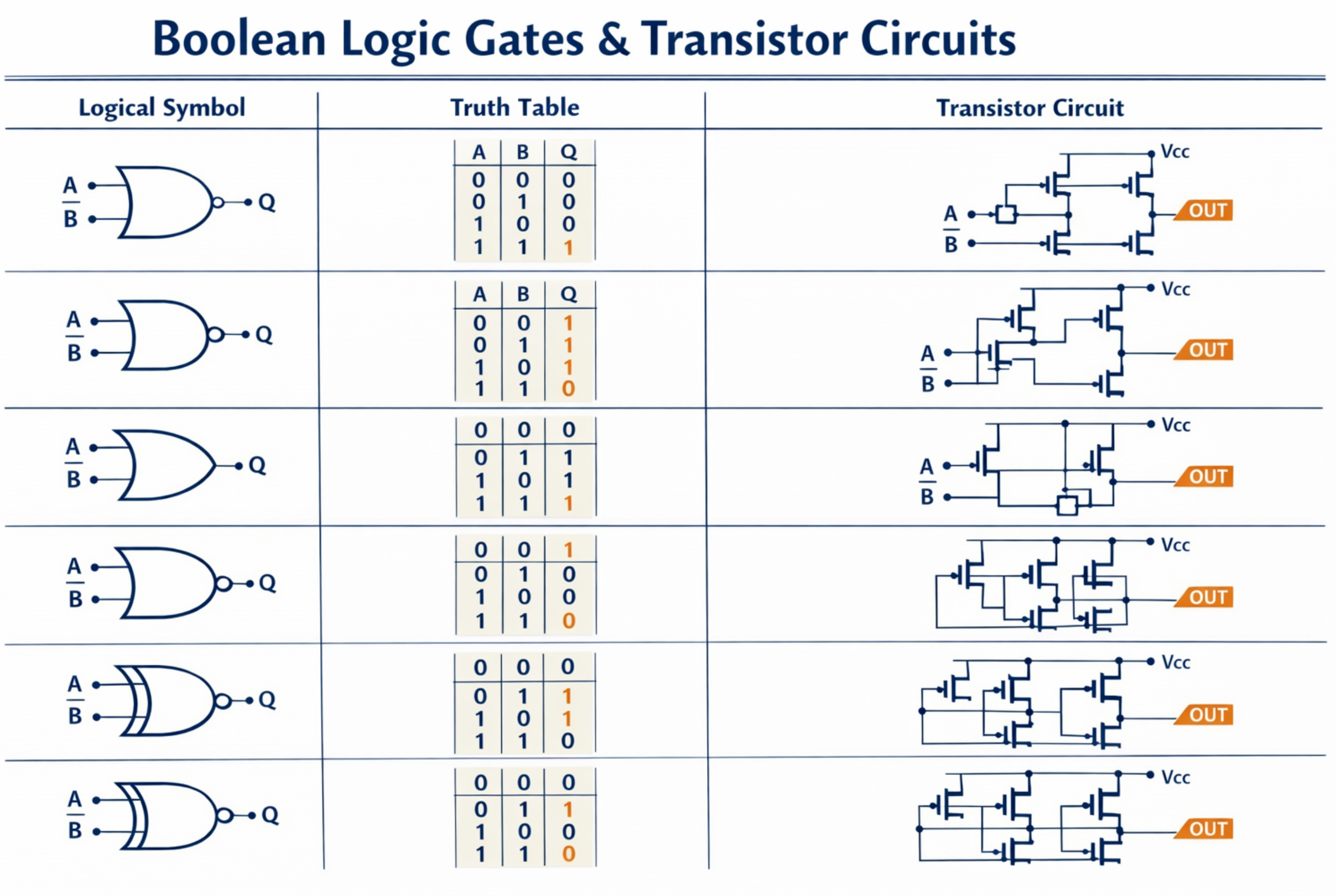
Binary logic dominates classical computing for reasons that are fundamentally engineering ones. Transistors switch between on and off. Voltage is either high or low. Two states are easy to distinguish 01, 10, 11, 00 etc. Boolean logic formalises how binary states combine, giving rise to the fundamental circuits of modern computing, such as NAND, XOR, and their relatives.
It’s not surprising then, to realise that when the first researchers began thinking seriously about quantum computation, they were steeped in this same tradition. The natural move was to reach for the closest quantum analogue of what they already knew. A system with two distinguishable states.
Also, I believe, it’s been obvious for a long while that the first workable quantum computers would need to be hybrids. That is some part of the system would do the quantum processing and then pass the results to a classical architecture which would then present the results to the user using the tried and trusted classical architecture stack.
In truth though, as we’ve seen many times now, considering the physical chemistry of all this; atoms have many energy levels. Photons carry more information than a single binary degree of freedom. Particles with spin greater than ½ have more than two natural orientations. Superconducting circuits, trapped ions, and other leading qubit platforms all host additional energy levels sitting just above the ones being used.
What we call a qubit is, more precisely, a two level subspace carved out of a richer physical system. The selection is deliberate and often ingenious researchers work hard to confine dynamics to just those two levels, to suppress leakage into the others, and to build control pulses that act faithfully within the chosen subspace.
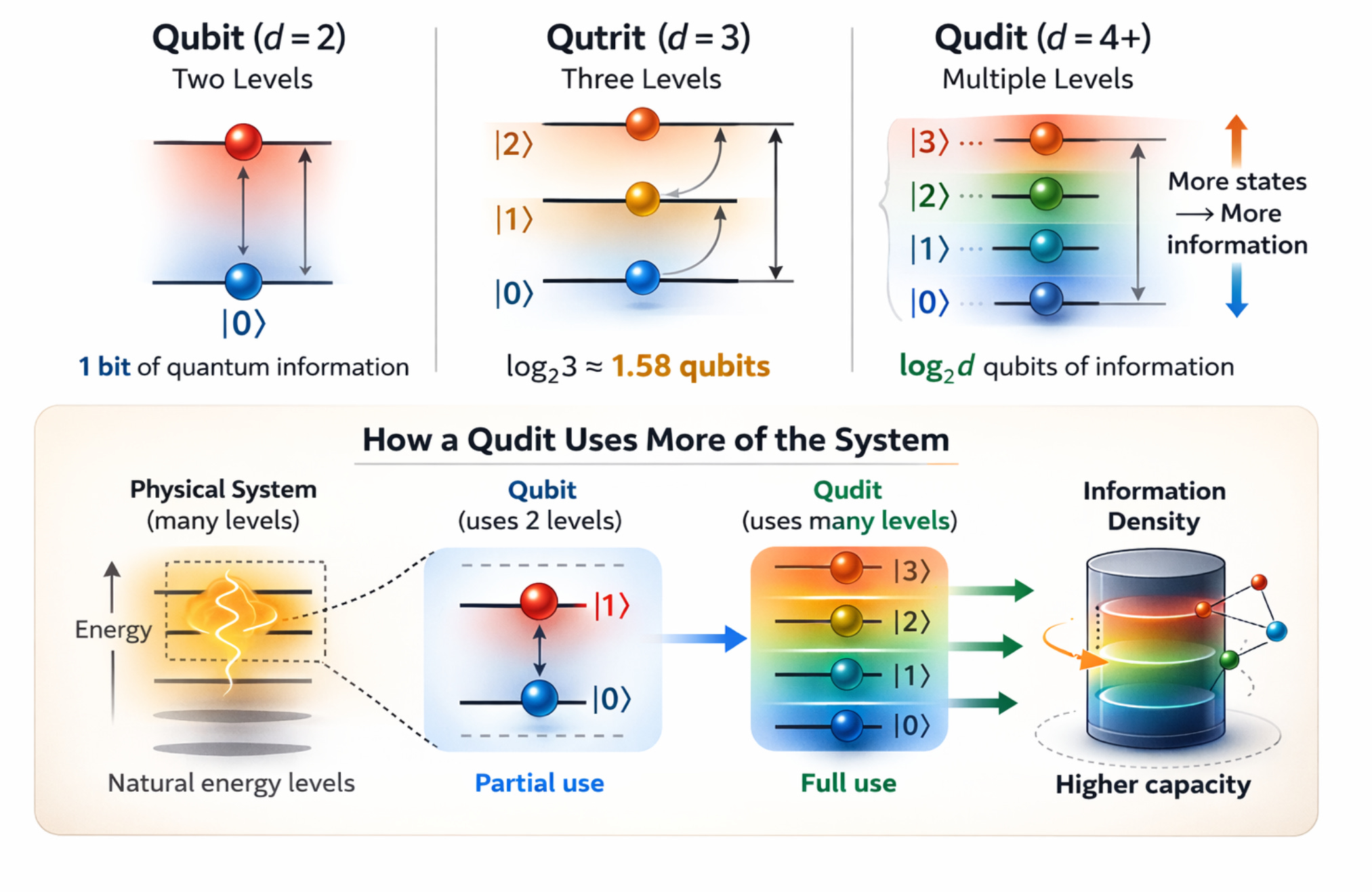
And so, now we have the Qudit! A qudit is simply a quantum system with d distinguishable levels, where d is greater than two. The simplest example is a qutrit, a three level quantum system with states ∣0⟩,∣1⟩,∣2⟩. Higher dimensional systems continue the pattern so a four level system would have states∣0⟩ through ∣3⟩, and in general a qudit can have many levels.
Treating a physical system as a qudit means choosing to work with more of its natural structure rather than less. Researchers working on quantum information have been aware of higher dimensional systems since the field’s early days.
As quantum hardware matured through the 2010s and into the 2020s, a set of inconvenient realities began pressing on the field. Scaling qubit systems turned out to be genuinely hard!
The overhead imposed by quantum error correction is staggering and estimates for fault tolerant computation routinely require thousands of physical qubits for every logical one. Gate counts ballooned. Connectivity between qubits on real hardware was limited, forcing circuits to route through expensive swap operations.
This convergence of pressures and opportunities have brought qudits back into serious consideration. If we can store more information per physical carrier, we potentially need fewer carriers to represent the same computation. Denser logical encoding can reduce circuit depth. Some operations that require multiple two level gates can be executed in fewer steps using higher dimensional systems. Certain quantum error correction schemes become more natural in higher dimensions.
Given all of this, it is worth pausing to ask why qudits remain almost invisible in public and general discussions of quantum computing.
Part of the answer is simple inertia. Educational materials take years to update. Journalists covering the field learned the qubit story and continue telling it. As we saw above it conveniently simplifies the situation when you’re explaining the basics to someone for the first time. I think its fair to say that introductory courses built around two level systems have not yet caught up with developments at the research frontier.
Also, part of it is, perhaps, a reasonable caution. Qudits offer genuine advantages in certain regimes, but they also introduce new engineering challenges. Control is harder. Error models are more complex. The field has not yet converged on a qudit based architecture the way it largely has around the qubit and hybrid architecture paradigm.
In the next article, we will look at how qudits are already appearing in real quantum hardware from trapped ions to superconducting circuits and why several major research groups are beginning to explore them seriously.
That’s all for now! If you like my efforts to make quantum science, computing and physical chemistry, more accessible to everyone; please consider recommending this newsletter on your own substack or website. Or share ExoArtDataPulse with a friend or colleague. Every recommend makes the project grow. Thanks for Reading!