

From Error Correction to Simulation
Why This Matters for the QMB

First up, If you’d like to support our equipment fundraiser, you’ll find the link here. And now, today’s post!
Every contribution, however modest, makes a real difference. And if you’re not in a position to contribute, sharing the campaign on social media is a powerful way to help spread the word! Thank you for your support.
And now, today’s post!
We started with a scratched CD.
That was eight posts ago, and it feels like a long time. Since then we’ve traveled through the no-cloning theorem and the strange prohibitions it imposes, through the geometry of surface codes and the abstract topology of LDPC graphs, through the brutal economics of physical qubit overhead and the philosophical question of what it means to represent information at all. Each post has been, in its own way, a different angle on the same underlying problem: how do you maintain reliable structure in a universe that is continuously, irreversibly trying to destroy it?
Now it’s time to bring the threads together. And to do that properly, we need to talk about what this series has been building toward all along and that is, what error correction means when the computational device and the physical phenomenon you’re studying are, at some level, the same kind of thing.
The Thread Running Through Everything
Measurement is how we extract information from quantum systems but measurement disturbs what it touches, and syndrome measurement is the art of asking indirect questions that reveal errors without collapsing the state being protected.
State is what we protect. The logical qubit, encoded non-locally across many physical qubits, existing in the relationships between them rather than in any one of them individually.
Evolution is where errors accumulate. Quantum systems don’t sit still, they evolve under noise, and the continuous drift of physical qubits away from their intended states is the fundamental problem that error correction exists to address.
Noise is the constant adversary; not an engineering inconvenience but a physical inevitability, present in every real system at every temperature above absolute zero, expressing itself as bit flips, phase flips, decoherence, leakage, and cross talk.
Representation is how codes are structured. The choice between geometric locality and graph-theoretic abstraction is not just a mathematical preference but a design philosophy that determines hardware requirements, decoding complexity, and the practical path to fault tolerance.
The very latest work in this space makes this point vividly: Alice & Bob's Elevator Codes, published in January 20261, abandon the assumption of hardware-agnostic design entirely. Built specifically around the biased noise profile of cat qubits; that’s physical qubits that passively suppress bit-flip errors but remain vulnerable to phase-flips. They use a single logical ancilla qubit that moves dynamically through layers of concatenated repetition codes, probing for errors at the logical level as it goes. The result is a 10,000-fold reduction in logical error rate at roughly three times the qubit overhead.
That dramatic accuracy gain for modest hardware cost is only achievable because the code is matched to the physics of the underlying qubit. Representation, it turns out, is not just about mathematical structure. It is about knowing what kind of noise you are living inside.
What a Quantum Many-Body System Is
A quantum many-body system (QMB2 for short) is any physical system in which large numbers of quantum particles interact with each other in ways that produce collective behavior impossible to understand by looking at the particles individually.
Superconductors. Topological materials. Strongly correlated electron systems. Quantum magnets. Ultra cold atomic gases. These are all quantum many-body systems, and they are among the most scientifically rich and technologically promising objects in condensed matter physics. Their collective quantum behavior; emergent phenomena arising from the interactions of thousands or millions of quantum degrees of freedom, is precisely what makes them interesting, and precisely what makes them extraordinarily difficult to simulate classically.
A classical computer trying to simulate a quantum many-body system runs into a fundamental obstacle; the quantum state space grows exponentially with the number of particles. Fifty interacting qubits require a state vector with more than a quadrillion entries to represent exactly. A hundred interacting qubits require more entries than there are atoms in the observable universe. Classical simulation of large quantum many-body systems is not merely difficult and for many systems of scientific interest, it is provably intractable.
This is one of the most compelling motivations for building quantum computers in the first place. A quantum system simulating another quantum system doesn’t face the same exponential wall. It operates in the same kind of state space as the thing it’s simulating. It can, in principle, track the evolution of a complex quantum many-body system efficiently because it is itself a complex quantum many-body system, carefully controlled3.
Error Correction as a Process, Not a Feature
A quantum computer simulating a quantum many-body system is not a clean, well-behaved device running a well-specified algorithm on noiseless hardware. It is itself a a collection of qubits subject to decoherence, a device operating in an environment that is continuously trying to degrade its quantum state. The simulator and the simulated are both quantum many-body objects. Both are subject to noise. Both require active management to maintain their quantum coherence.
Error correction, in this context, is not a module bolted onto the outside of the computation. It is woven into the fabric of how the device operates. Every logical qubit in the simulation is being actively maintained by continuous syndrome measurement and correction cycles running underneath the simulation itself. Every gate in the quantum circuit implementing the simulation is a fault-tolerant logical gate, executed across encoded qubits with error correction happening in parallel.
The simulation and the error correction are not sequential. They are concurrent. The device is simultaneously computing and protecting its own computation running the physics it was designed to study while continuously fighting the noise that would otherwise destroy it.
This is what it means to say that error correction is a process rather than a feature. It is not something the machine does before the real work starts, or checks on occasionally between computational steps. It is the continuous operational condition under which reliable quantum computation and therefore reliable quantum simulation, becomes possible at all.
The Hybrid Quantum-Classical Loop
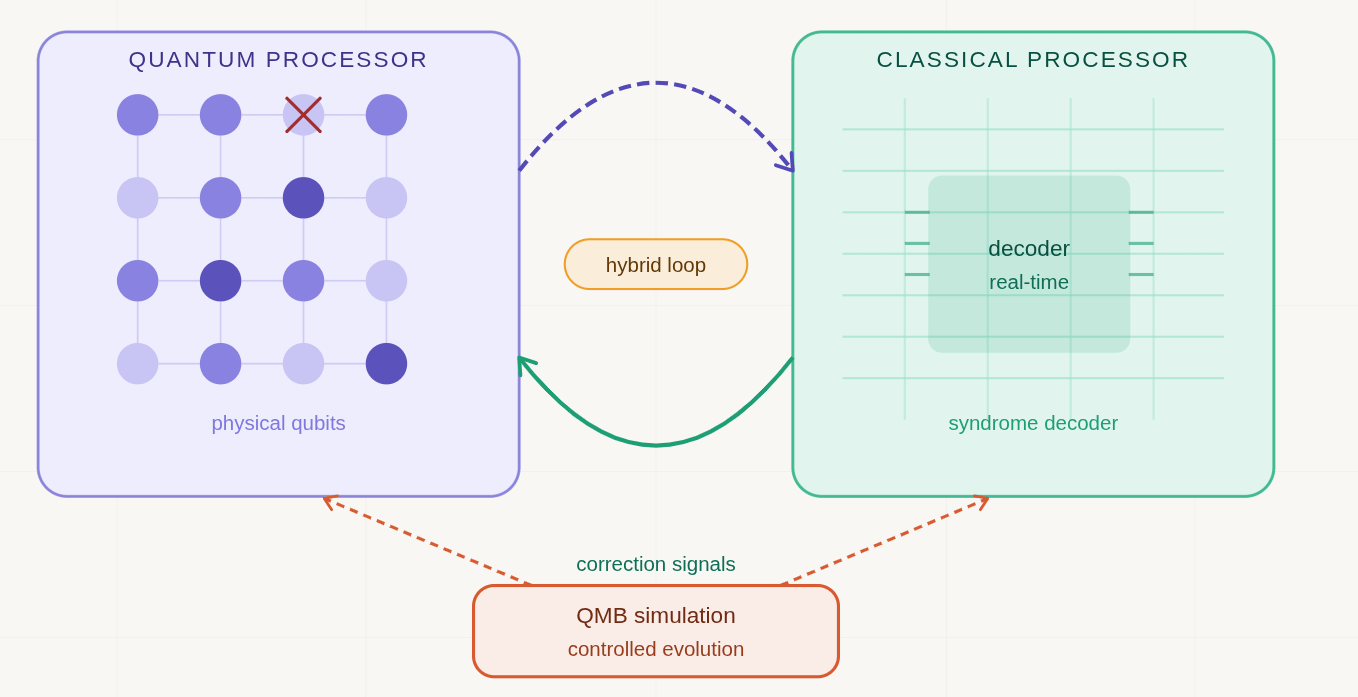
Fault-tolerant quantum simulation doesn’t run on quantum hardware alone. It runs on a tightly integrated hybrid system in which quantum and classical processors operate in continuous dialogue.
The quantum processor holds the encoded logical qubits, the quantum state of the simulated system, protected by error correcting codes, evolving under the Hamiltonian the simulation is designed to implement. The syndrome measurement circuits sample the error landscape continuously, generating a stream of classical data that describes the current error state of the physical hardware.
The classical processor, fast, powerful, running in real time alongside the quantum device, receives that syndrome stream and runs the decoding algorithm. It infers the most probable error configuration, decides what corrections to apply, and sends correction signals back to the quantum hardware on timescales faster than errors accumulate. It may also be running variational optimization loops, updating parameters in the quantum circuit based on measurement outcomes, adaptively refining the simulation as it runs.
This loop, quantum state evolving, errors occurring, syndromes measured, classical decoder inferring, corrections applied, quantum state continuing; is not a design choice. It is the fundamental operational architecture of any fault-tolerant quantum device. The quantum processor provides what classical hardware cannot: exponentially large state spaces, genuine quantum parallelism, the ability to track quantum many-body evolution efficiently. The classical processor provides what quantum hardware cannot: fast, reliable, deterministic information processing, real-time decoding, adaptive control.
Neither is sufficient alone. Together, they constitute a machine capable in principle, and increasingly in early practice, of doing something no purely classical device can do.
Simulation as Controlled Evolution With Correction
There is a way of describing what quantum simulation actually is that pulls everything in this series into focus.
Quantum simulation is controlled evolution with correction.
Controlled: The Hamiltonian governing the system’s evolution is chosen and implemented deliberately, designed to reproduce the physics of the target system the superconductor, the topological material, the strongly correlated electron system within the quantum processor.
Evolution: the quantum state of the encoded system evolves unitarily under that Hamiltonian, tracking the genuine quantum many-body dynamics of the thing being studied. The exponentially large state space evolves coherently, carrying information that no classical representation could efficiently hold.
With correction: error correction runs continuously underneath, maintaining the coherence of the evolving state against the noise that would otherwise degrade it into a useless mixture of classical probabilities. Without correction, the simulation decoheres. With correction, it persists long enough to be measured, interpreted, and understood.
This controlled evolution with correction applies equally to quantum simulation of condensed matter systems, to fault-tolerant quantum computation for cryptography or optimization, and to the quantum many-body sensing devices being developed for precision measurement. The architecture is the same. The challenge is the same. The tools we’ve built up across this series; syndrome measurement, logical encoding, surface codes, LDPC graphs, threshold theorems, hybrid classical-quantum loops; are the tools required in every case.
What This Series Has Been
Start with error. Introduce the strange constraints quantum mechanics places on how errors can be detected and corrected. Build up the architecture of protection layer by layer — encoding, syndrome measurement, geometric codes, abstract codes, overhead, threshold, representation. Then zoom out and ask what it all means when the device and the phenomenon it studies are both quantum many-body systems operating under the same physical laws.
The answer is that quantum error correction is not a technical footnote to quantum computing. It is the condition of possibility for quantum computing. It is the framework that makes it conceivable to perform reliable operations on physical systems that are continuously, irreversibly subject to noise.
And quantum simulation of many-body systems is perhaps the most natural application of that framework, because it is the domain where the need is clearest, the classical alternatives are most obviously inadequate. The potential payoff, i.e. understanding the collective quantum behavior of matter at a level we currently cannot reach is most profound.
Every system makes mistakes. The universe does not preserve information for free. Quantum mechanics forbids the easy solutions. And yet, through careful encoding, indirect measurement, continuous correction, and the tight integration of quantum and classical processing, something remarkable becomes possible and that’s reliable computation in an unreliable world.
That’s all for now! If you like my efforts to make quantum science, computing and physical chemistry, more accessible to everyone; please consider recommending this newsletter on your own substack or website. Or share ExoArtDataPulse with a friend or colleague. Every recommend makes the project grow. Thanks for Reading!
Support our workstation fundraiser here :-)
Ruiz, D. and Shanahan, P., “Elevator Codes: Concatenation for resource-efficient quantum memory under biased noise,” arXiv:2601.10786 (21 January 2026). Alice & Bob’s cat qubits suppress bit-flip errors passively via two-photon confinement, reducing the error correction problem from two dimensions to one — solvable by a classical repetition code. Elevator Codes reintroduce active bit-flip correction at the logical level by running a single logical ancilla qubit through a concatenated stack of repetition codes, performing syndrome checks and resetting between passes. The outer code layer targets bit-flips at high rate; the inner layer preserves a high phase-flip threshold — decoupling the two error channels that the hardware already treats asymmetrically. The projected outcome is a 10,000-fold reduction in logical error rate at roughly three times the baseline qubit overhead, with 100 logical qubits reachable from approximately 1,500 physical cat qubits.
Not to be confused with ExoArtDataPulse’s ‘Quantum Money Box’ project. Ongoing.
If this sounds familiar, its because it is. In fact its famous in the annals of quantum computing. I.e. Richard Feynman (1981) argued: “Nature isn’t classical, dammit, and if you want to make a simulation of nature, you’d better make it quantum mechanical.” He proposed that a machine operating on quantum laws could inherently replicate the state spaces of quantum physics, turning an intractable simulation into an efficient one