

Physical Chemistry.
Moving from atomic to subatomic...

Happy New year Everyone! Welcome Back! I hope the new year has got off to a good start for you all and even if its been a bumpy ride back to work, or college here’s something to look forward to!
I’ve felt for a while that somehow, Math, Quantum Science in general and Quantum Computing in particular weren’t quite enough strands for this blog. In the run up to Christmas we looked at how we can introduce the ‘Home Brew’ component in the form of micro electronics and Digital Audio Workstations (DAW) to aid us in visualising waves and wave functions.
Still I’m listless, or was until the penny dropped and I realised what we are missing to complete our bag of goodies and that’s Physical Chemistry. Many high school colleges and undergraduate curriculums include Math, Physics and Chemistry. But not many take a focused look at ‘Physical Chemistry’ - the actual study of what goes on at the molecular, atomic and subatomic aspects of the elements as we know them.
It’s a long time since I had a proper look at the periodic table, probably in the seventies and goodness me, how it has grown!1
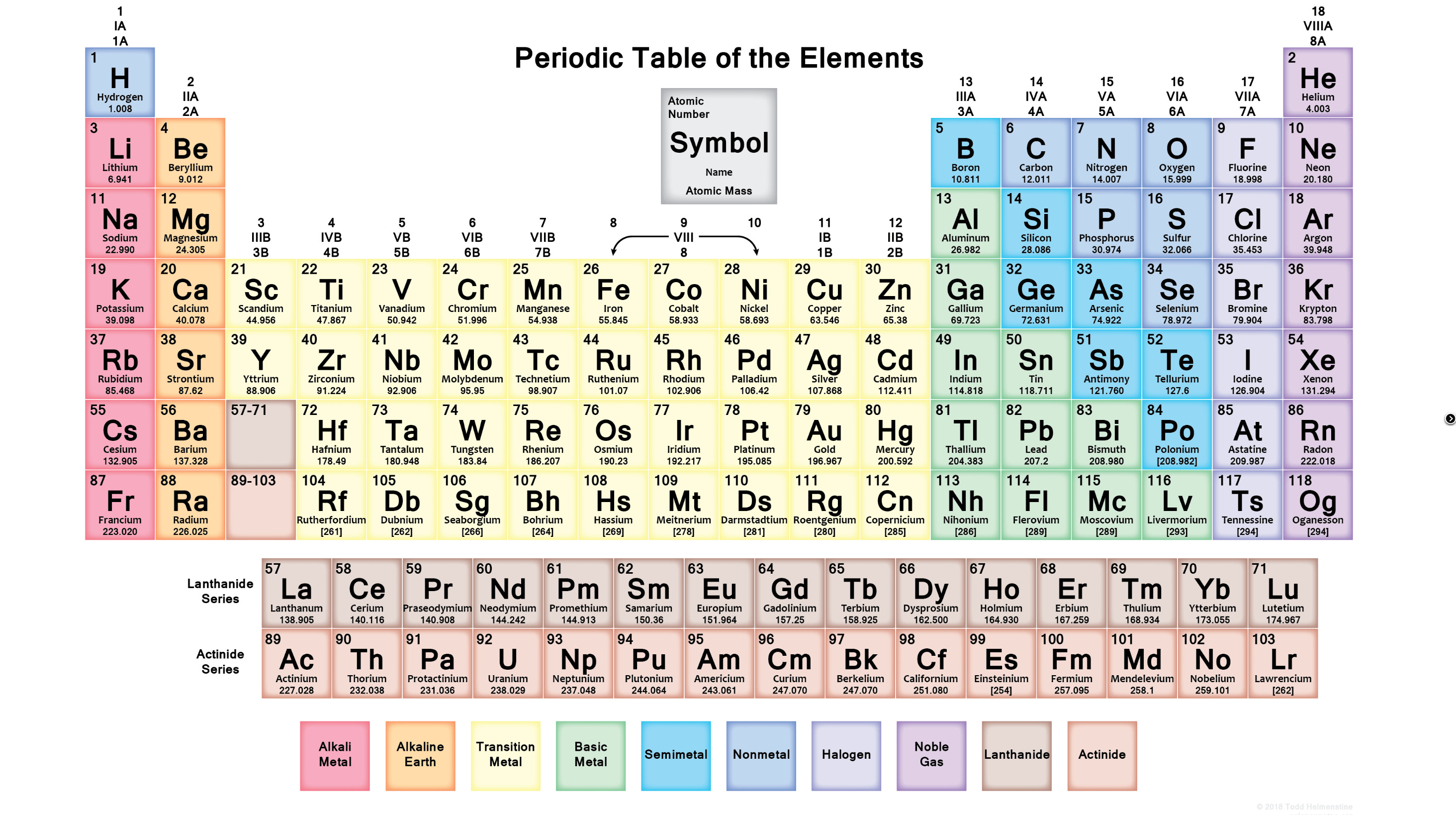
After all, if we are going to spend much of our time speculating upon, and obsessing about all things quantum, we really ought to get down and dirty with the elements right? Nature’s tool and paintbox, right there, just waiting for us to dip in.
I first came across Physical Chemistry as an independent discipline in 2023 in Falmouth University Library (UK). Its a bus ride from where I live and I like to get out once a week to get some fresh air (its by the sea) and get some actual, away from the monitor, quality reading time. The book I came across, and so loved it I found a copy on eBay, is G I Brown’s, ‘Introduction to Physical Chemistry’. I can really recommend this easy to read book by a giant in the field. First edition in 1964. I’ve got the eighth edition published fifteen years later2
Given that we’ve already seen that quantum computing is predicted to be especially useful in Chemistry3 we would do well to dip our toes in this most interesting subject. Here goes!
For me, Physical Chemistry sits at the exact intersection of mathematics, physics, and chemistry and for me at any rate, provides precisely the blend that underpins quantum science. I believe it offers the tantalising prospect of linking microscopic theory to macroscopic observables (spectra, energy levels, phase transitions). That is, the very things our home brew, low budget4 approach to Quantum Studies could access with a bit of electromagnetic ingenuity and creative thinking.
In Physical Chemistry, energy exists in discrete levels (as ‘s, p, d, f’, levels) see below and also note 5. With great serendipity, and in its own way, so does Quantum Mechanics! At the smallest scale, quantum mechanics describes how particles such as electrons, atoms, molecules behave. Wavefunctions (ψ) describe probabilities, not certainties; and transitions between states involve the absorption or emission of specific quanta (photons, phonons, etc.)
So in effect Physical Chemistry sets our wandering journeymen (and ladies) feet on the path to what you might call microscopic theory: it deals with individual particles, states, and interactions.
With it I believe we can come to grips with demonstrating quantum principles in a tangible form, e.g. electron orbitals, photoelectric effect and molecular bonding. Electrons in atoms don’t orbit like planets. They exist in quantized standing waves described by solutions to Schrödinger’s equation
This is the ‘Time-Independent’ version of the equation, used for systems in stable energy states (stationary states), where E is the energy. The Hamiltonian (𝐻̂) is an operator representing the total energy of the system. That is, the sum of kinetic and potential energy. 𝜓 or Psi as we already know, from previous posts, stands for the state wavefunction of a quantum system.
In Physical Chemistry, each energy orbital is named as ‘s, p, d, f’5 and corresponds to a specific energy level and probability distribution for finding an electron.
Physical Chemistry translates these abstract solutions into real visual and measurable forms using;
Spectroscopy: Each element’s line spectrum corresponds to transitions between orbitals. Displayed as sharp, coloured lines you can observe in a lab using a prism or diffraction grating.
Photoelectron Spectroscopy (PES): In more advanced setups, you can measure the energy required to remove electrons from each orbital, directly confirming the predicted energy levels.
Computational Visualization: Perhaps we can aim to plot ψ² as 3D density clouds using Python or Jmol thereby visualising orbitals as tangible geometric forms.
Ground electromagnetics and electronics in real physical phenomena like dielectric polarization, conductivity, or even reaction energetics.
So, in essence, if we get it right over this next year, Physical Chemistry could be our bridge between the quantum world and the bench-top world. How cool is that?
That’s all for now! If you like my efforts to make quantum science, computing and physical chemistry, more accessible to everyone; please consider recommending my newsletter on your own substack or website. Or share ExoArtDataPulse with a friend or colleague. Every recommend makes the project grow. Thanks for Reading!
From 103 elements in 1969 to 118 today! See the free to download and print periodic tables by courtesy and copyright of Science Notes
‘Introduction to Physical Chemistry SI Edition’, 1974, Brown, G I, BA, BSc, Pub. Longman
See the post on this on ‘Quantum Computing and Chemistry’, October 24th 2025
That is, practically non existent budget. Though I hope to do some project oriented fundraising as the year wears on.
There’s an A level introduction to s,p,d,and f here Atomic Structure or if you prefer, lesson one of a whole course on energetics here Lesson 1 of 24 lessons in Physical Chemistry. Personally I found lesson one of the series easier to understand how s,p,d,f work.