Waves Part 1 Capture
From Riemann spheres to real waves

In our recent four-part series on Riemann surfaces, we explored how complex structure lets us tame infinities, track continuity through branch cuts, and describe rotations that cannot be captured on a single real axis. In quantum science, as we’ve seen before, this occurs in in probability space, not physical space. In phases and amplitudes rather than positions and trajectories.
Today, we are complementing approaches to describing mathematical surfaces to taking a look of radio waves out in the wild. For me, starting to stuudy what waves really are by recording radio waves is a no brainer and we can route the signals directly into our DAW i.e. Tracktion, or Ardour, Audacity et al. Short-wave radio reminds us that the space around us is alive with oscillations. Signals layered on signals.
If you want a legendary tale of epic intercepted radio signals, check out the WOW! signal from 19771. Like me the story is a bit long in the tooth but it does repay the reading.
Ok, we’re not listening out for ET to call home, ours is a more focused quantum level wave frontier but we do have to start getting down and dirty with waveforms. I think ‘hands on’ should accompany the math or we’ll lose sight of the phenomenon we are dealing with and I can’t think of a better place to start.
Just spinning the dial at random we’ll hear carriers holding steady for long stretches, then slowly fading as conditions change. We’ll hear rhythmic beating where nearby frequencies overlap. We hear sudden spikes that appear without warning and vanish just as quickly. You hear broad hiss that sounds uniform until you listen closely and realise it is anything but.
As I mentioned in last weeks’ accountability report, for the Quantum Music Box (QMB) we will use a dongle, i.e. software defined radio (SDR)2 but as a proof of concept just turn on any shortwave radio, or am/fm if that’s all that’s available in your vicinity. Analogue rather than digital for preference this time round, and record the radio waves into your DAW just to see some.
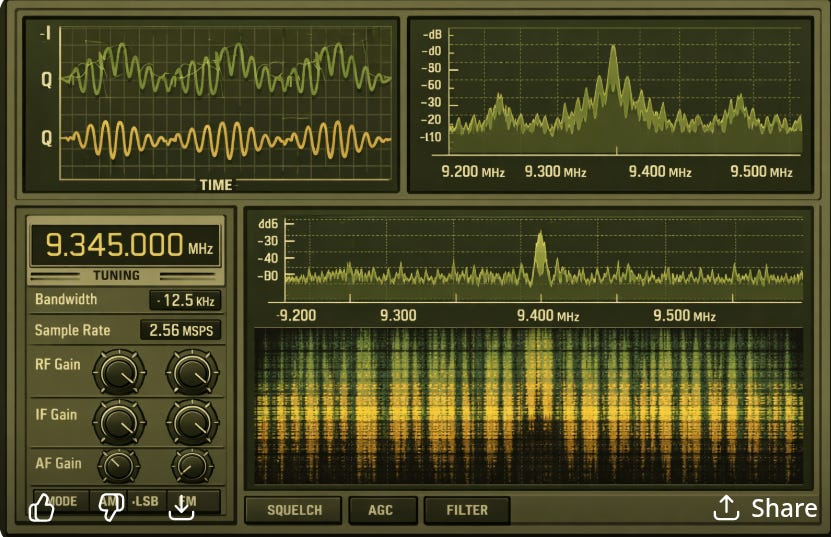
There’s such an enormous variety to be had and we’ll see how they interfere with one another. Which ones seem sensitive to tiny changes, which ones buzz chaotically. This is not noise in the everyday sense. It is information without context3.
The distinction matters because the same thing happens in quantum systems. In quantum mechanics, noise is often framed as the enemy. Something to be eliminated, suppressed, corrected4. But noise is not randomness in the naive sense. It is uncontrolled interaction. From a chemical point of view, a fly in the ointment.
A qubit becomes noisy because it is still talking to, or perhaps more accurately listening to, the universe. Thermal motion in the hardware. Stray electromagnetic fields. Vibrations in the substrate. Measurement itself feeding back into the system. Each of these is another signal competing for the same space.
Any amount of time playing with short-wave radio tech makes this obvious. We are never hearing one thing. We are hearing the result of many processes occupying the same physical medium. One of the first features to listen for in a short-wave recording is beating. That slow oscillation in loudness when two nearby frequencies overlap. It is interference made audible.
In quantum mechanics, interference is not an inconvenience layered on top of the theory. It is the theory. Superposition only becomes visible when probability amplitudes interfere with one another.
The problem is not interference in and of itself. The problem is unwanted interference. Once the recording is complete the DAW becomes less like a studio tool and more like a microscope. Zooming in reveals slow amplitude modulations that were invisible at first. Stretching time exposes repeating structures buried in what sounded like featureless hiss.
Spectral views show bands that breathe and drift rather than sitting still. Transient bursts appear that do not belong to any recognisable station, yet clearly have internal structure. Doing this we are able to ask what stays stable and what refuses to be pinned down. A similar shift happens when we stop treating qubits as abstract symbols and start treating them as physical wave systems embedded in an environment.
Short-wave radio lets us hear what quantum engineers have to model. It gives us a visceral sense of what it means to work with signals that cannot be fully isolated. Once we have listened carefully, it becomes harder to think of quantum noise as a mysterious flaw. It starts to look like physics behaving normally under tight constraints.
This is where quantum error correction often gets misunderstood. It is easy to imagine error correction as suppression. As silencing noise. As forcing the system into obedience. But the more accurate picture is selective listening.
Quantum error correction works by learning which interference patterns matter and which can be safely ignored. It does not remove interaction with the environment. It structures it. It measures correlations. It distinguishes signal-bearing patterns from background dynamics.
Error correction is not about making the universe quiet. It is about learning how to hear through it. When we record radio waves we are capturing structure. Quantum mechanics asks us to do the same thing. As we progress we will learn how patterns survive, degrade, and sometimes re-emerge through interference.
That’s all for now! If you like my efforts to make quantum science, computing and physical chemistry, more accessible to everyone; please consider recommending my newsletter on your own substack or website. Or share ExoArtDataPulse with a friend or colleague. Every recommend makes the project grow. Thanks for Reading!
There’s a great working demo of available SDR dongles in action and what the tech is all about here. There is also a longer description of the tech does, with tips and tricks, and even points out that you can plug one into a raspberry pi board to create a budget radio receiver with impressive software support! here
On a practical note, I should point out that all my systems are Linux PCs and while SDR software for the dongles exist there doesn’t seem to be as comprehensive coverage as you might get for a Windows PC or a Mac.
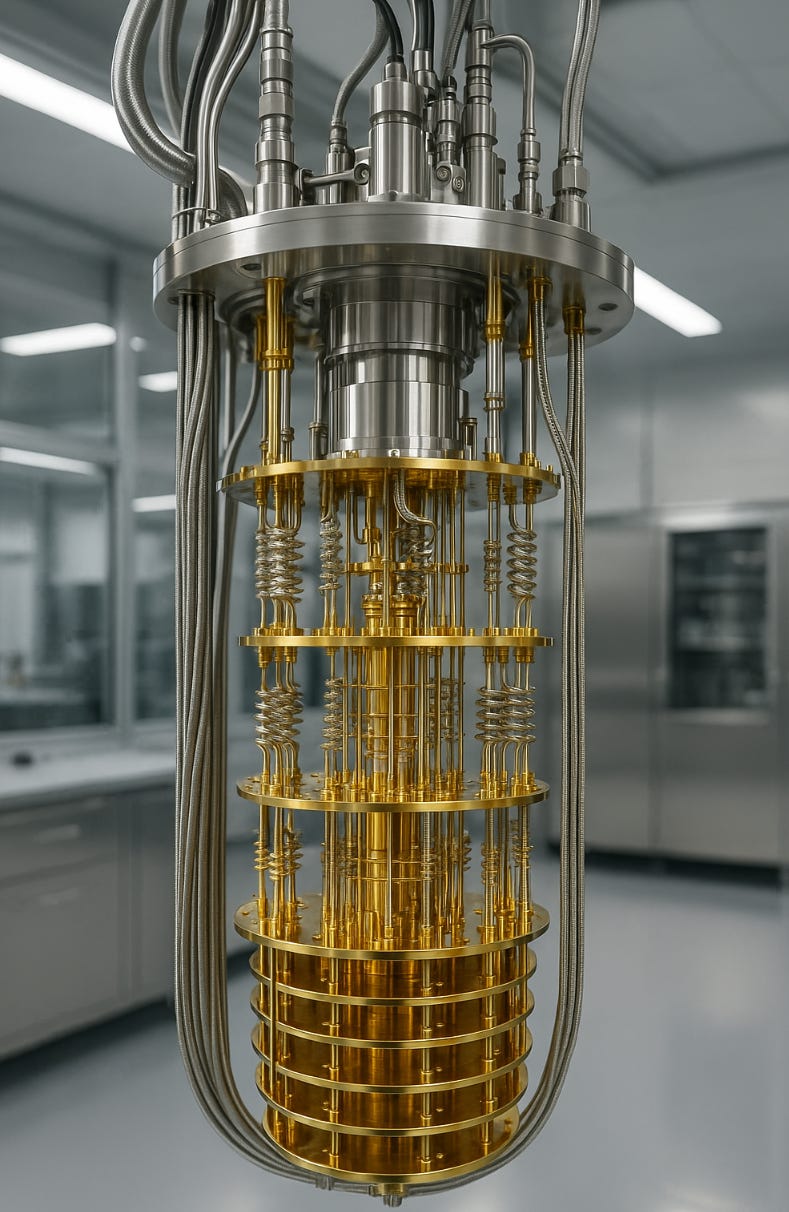
Hence the mega expensive super cooling units you often seen displayed when discussing quantum computers.