

Waves Part 2 Topological Quantum Computing
Exploring Maxwell–Boltzmann distributions and sculpting quantum wave forms

This February we’ve seen a good deal of abstraction in our treatment of Riemann spheres and now it’s time to get a bit more physical. That is to say, in classical physics, we assume we can know everything about a particle but the truth is, in the quantum world, a of waves and distributions we have to admit that we can’t. Probability is the bridge that allows us to talk about trillions of chaotic molecules as a single, predictable system like temperature or pressure.
As we’ve seen many times now, in quantum mechanics, particles don’t move like billiard balls; they travel as wavefunctions. To recap, a couple of terms, ‘Interference’ we can think of as being like ripples in a pond, these probability waves can add up to a result and we call these ‘constructive interference’. On the other hand, they may cancel out a result by causing it to collapse and this we know as ‘destructive interference’. Regarding energy levels. When a wave is confined like an electron in an atom, it can only vibrate at specific frequencies. This quantization means the particles can only occupy specific energy rungs.
Good to know, but how do we keep track of all this activity? Well, we could make a start by considering what speed everything is travelling at. For instance, the Maxwell-Boltzmann distribution is the statistical result you get when you have a large collection of classical particles in thermal equilibrium, colliding elastically1.
While individual particle motions are chaotic and unpredictable, the Maxwell-Boltzmann distribution describes the probability distribution of particle speeds in a gas. It is a probability density function that tells us how speeds are spread out among particles at a specific temperature.
Key characteristics include an asymmetric curve that peaks at the most probable speed, a long tail toward high speeds, and strong temperature dependence. Higher temperatures shift the peak to higher speeds and broaden the distribution. It isn’t a perfect bell curve. It is skewed to the right because particles can’t have a speed lower than zero, but they can, theoretically, have very high speeds. Regarding temperature dependence, as temperature increases, the “peak” of the curve shifts to the right and flattens out. This means the average speed increases, but the variety of speeds also becomes much broader.
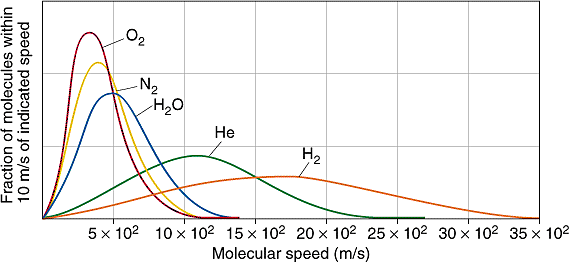
Consider the above gases in a container. Probability tells us we can’t actually track one molecule but we can track the group. Waves define the energy states those molecules are in. Maxwell-Boltzmann is the final “tally” that shows how many molecules are actually sitting in each energy state at a given temperature. In short, the distribution is the macroscopic map of the underlying microscopic waves.
So far so good. But how does this apply to quantum computing? In quantum mechanics, a wave function is a state vector. A quantum gate is a Unitary Operator (U)2. From a geometric perspective, we can think of the wave as a shape and the gate as a specific type of rotation or reflection.
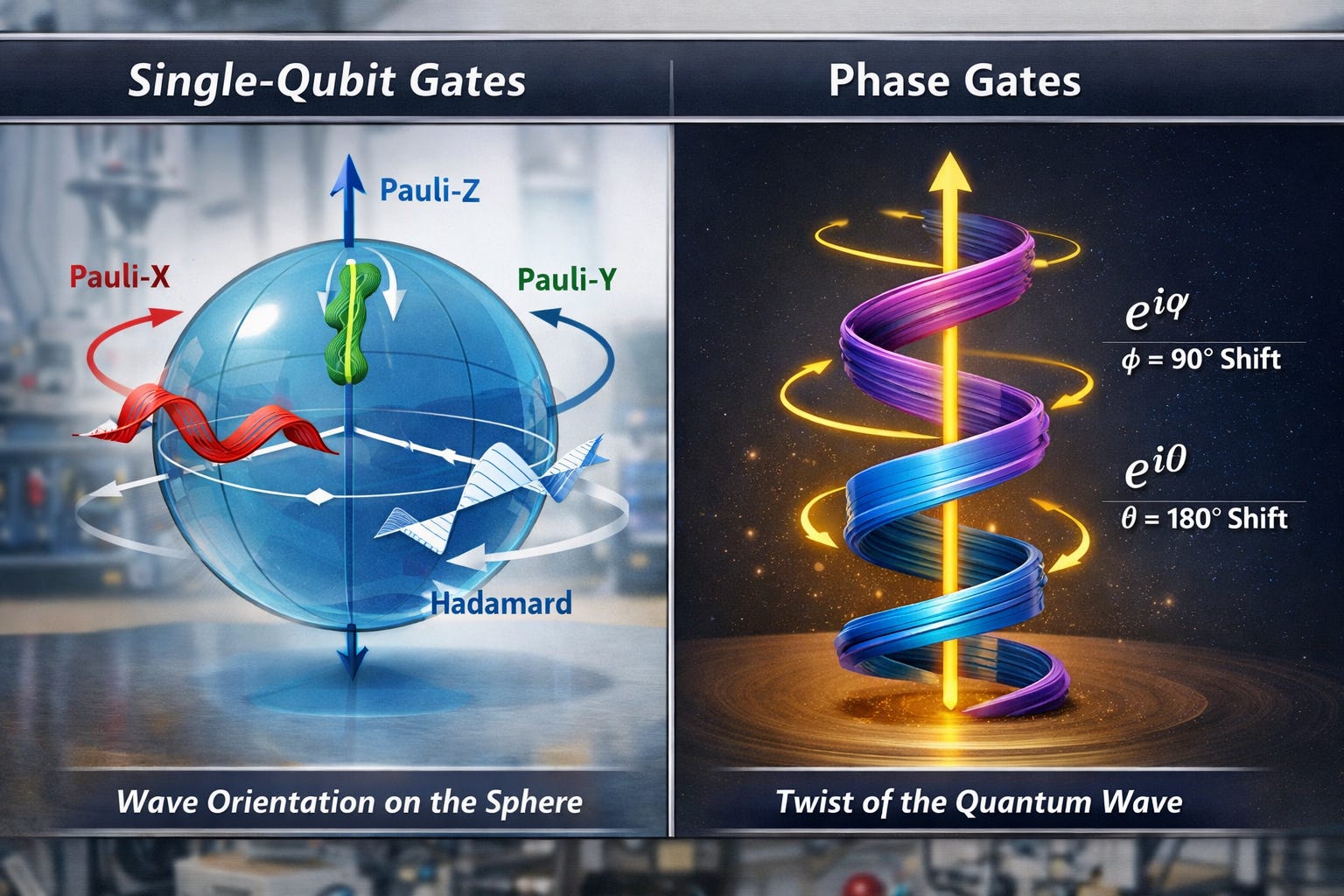
For instance, Single-Qubit Gates like Pauli-X, Y, Z or Hadamard categorize wave shapes by their orientation on the sphere. On the other hand, Phase Gates specifically target the “twist” of the wave. If you think of a quantum wave as a corkscrew, a phase gate determines how many times that corkscrew winds around a central axis.
Broadly speaking, there are two major categories of wave gates to consider. The Clifford Group consists of Hadamard, CNOT gates. The phase gate category moves waves between highly symmetric, “stabilizer” states. Waves manipulated by these gates are “simple” enough that they can be simulated on a classical computer. Non-Clifford Gates such as the T-gate, warp the wave shape into non-stabilizer states, creating the complex interference patterns required for true quantum speedup.
Finally, we can summarise all this by building on our discussion of the Riemann sphere and loop topology because we can now see how these ideas manifest in what you might describe as ‘topological quantum computing’3. When the idea struck me, I was thinking literally (my adhd again) in terms of sculpting wave forms with various forces. However, a quick search of arxiv.org shows it to be an established topic in its own right. See note 3. below. Let’s call it TQC for now.
In TQC, quantum gates are implemented through the braiding4 of anyon5 worldlines in 2 spatial dimensions (x, y), and 1 time dimension (t)6. So in TQC anyon worldlines traced through spacetime form such braids, and the braid group structure directly corresponds to the quantum gate operations we can perform. So yes, sculpting the waves but a bit more complex than the term might suggest at first, though surely not surprising given what we’re about.
Crucially, the quantum state is determined not by the precise geometric path of the braid, but by its topological class. Braids that can be continuously deformed into one another represent the same operation. Local noise can deform the path slightly, but as long as it doesn't change the topological class of the braid, which would require a major, non-local disruption, the quantum operation remains unchanged.
That’s all for now! Though I feel we’re only just getting started on TQC. More to come I think, downstream. If you like my efforts to make quantum science, computing and physical chemistry, more accessible to everyone; please consider recommending this newsletter on your own substack or website. Or share ExoArtDataPulse with a friend or colleague. Every recommend makes the project grow. Thanks for Reading!
Hard not to think of pool balls rocketing around the baize looking for a pocket, I know, but hang on to the fact these are waves we’re talking about. It’s just that for some discussions the notion of particles just works quite well.
In quantum computing, an ideal quantum gate is a unitary operator. This means it changes a quantum state in a way that preserves total probability and can always be reversed. Physically, a unitary operation does not destroy information it only redistributes amplitudes and phases. We can think of a quantum gate as a controlled “rotation” of the state in abstract probability space rather than a physical movement in space.
On the other hand, processes like measurement or noise are not unitary, because they involve information loss or collapse. But as long as we are talking about ideal gates inside a quantum circuit, their action is always unitary.
The term ‘braiding’ comes from the mathematical theory of braid groups, introduced by Emil Artin in 1925. A braid is a precise topological object: a collection of non-intersecting paths (strands) that can wind around each other, where two braids are equivalent if one can be continuously deformed into the other without strands crossing.
Anyons are quasiparticles that can only exist in two-dimensional systems. The name comes from the fact that they can have any quantum statistics, not just the two types we’re familiar with in 3D:
In three dimensions, we only have Fermions (electrons, quarks, etc.) When you exchange two identical fermions, the wave function picks up a phase of -1 (it flips sign) and Bosons (photons, Higgs, etc.) exchange gives a phase of +1 (no change).
In two dimensions, Anyons can pick up any phase angle when exchanged (hence “any-on”) Even more exotic, some anyons have ‘non-abelian statistics’, meaning the order in which you braid them matters for the final quantum state which is what makes them useful for quantum computing.
You may see this abbreviated as ‘2+1 dimensions’, from time to time. It doesn’t mean two plus 1 dimensions.